Monday, July 17, 2017

The Star of the East: Umm Kulthum


I have had quite the sabbatical from blogging! Since September, I have been fiddling with revisions to my novel (historical fiction, natch). In May, all that fiddling finally came to fruition as an idea that I liked, and on Friday, I at last finished my new draft and sent it off to some friends who have generously agreed to read it and give me feedback so that I can tweak it a little bit more before sending it back to my agent.
In the meantime, while the manuscript is in someone else’s court, I can focus my writerly attention on some of the projects I have neglected of late. It seems fitting that my first new post should feature a woman who is a background detail in my book, a woman who is possibly the most revered singer in the Arab world: Umm Kulthum.
This is how Virginia Danielson, a Harvard musicologist and author of “The Voice of Egypt” describes Umm Kulthum:

Imagine a singer with the virtuosity of Joan Sutherland or Ella Fitzgerald, the public persona of Eleanor Roosevelt, and the audience of Elvis, and you have Umm Kulthum, the most accomplished singer of her century in the Arab World.

            Umm Kulthum lived through a time of enormous changes in Egypt, changes which she successfully navigated, and sometimes, even helped shape. She simultaneously became the voice of an old Arabic culture and the new, modern, uniquely Egyptian one. She was in many ways, the narrator of Egypt’s twentieth century. Yet, despite being such a large public figure in Egypt, little is known about her personal life.
Umm Kulthum was born in rural Egypt, sometime in the turn of the century – probably between 1898 and 1904, but the exact date is unknown. She was named after one of the Prophet Muhammad’s daughters, who later became the wife of one of the first “rightly-guided Caliphs” after Muhammad’s death. In Arabic, Umm (or Um) literally means “Mother of” but can also mean “the woman with.” Umm Kulthum can be translated as “the one with the round face.” (The male version would be Abu, which means “father of” and can also mean “man with.”  Many adults have nicknames in this style that relate them either to a person – their literal offspring – or to some physical feature. My personal favorite is that Iraqi communists called Joseph Stalin Abu Sharib/Abu Shanab: the man with the mustache. But I digress.)
Umm Kulthum’s father was a Shaykh – a mid-level scholar of Islam, who was mainly called upon to recite passages of the Qu’ran and sing religious songs at important events, such as weddings. In Arabic, Qu’ran means recite and in religious families it is common for both boys and girls to learn to recite the Qu’ran in unadulterated classical Arabic, often by singing or chanting the poetic suras. Umm Kulthum was famous for her excellent diction of the classical Arabic poems that she sang, as well as the emotion she infused in the words: some credit these talents with her childhood memorization of the Qu’ran.
It was clear from a young age that Umm Kulthum had a powerful voice. Her father began to bring her along with him as he travelled the Nile Delta to sing for his clients. Being a conservative Muslim, he did not feel comfortable having his daughter sing in front of strange men, and so he dressed her as a boy for the first several years of their travels. Umm Kulthum’s performances helped to supplement her father’s meager income, while also drawing the attention of wealthier and more important clients. By the early 1920s, with the help of her clients, she and her family moved to Cairo, by then a rapidly growing and changing city.
Umm Kulthum, on the left, dressed as a boy.

The Middle East of the 1920s was swept up in a revolutionary fervor. The centuries-old Ottoman Empire had died with the end of World War I, and new states were emerging from its ashes, each struggling to strike a balance between autonomy from Western Imperial powers, Western-style modernity, and unique national identities based on local culture. A failed revolution in 1919 against British rule did little to quench the revolutionary thirst in Cairo and this revolutionary spirit manifested itself in the arts. After the 1919 revolution, women became a much more visible part of Egyptian culture, particularly in the entertainment industry. This was a trend that both enabled Umm Kulthum’s rise to fame, but also, one that set her apart. Female singers and dancers (as in many cultures) tended to be seen as disreputable. Often, these women wore a lot of makeup and jewelry, perhaps even scandalous dresses. Umm Kulthum, by contrast, wore conservative, often simple, cotton dresses and almost exclusively sang religious poetry. At first her course manners made Umm Kulthum and object of ridicule, but after a little cultivation from some of her patrons, her country charm became part of what endeared her to her audience. She was famous for wearing a long-sleeved, floor-length gown and clutching a scarf in one hand whenever she performed.


Two prominent features of the early twentieth century helped turn Umm Kulthum into the giant she was: first, mass media, and second, the Egyptian nationalist soul search for an indigenous Egyptian culture. Radio, the medium that helped propel the careers of Adolph Hitler, Benito Mussolini, Franklin D. Roosevelt, and Winston Churchill, also made Umm Kulthum a star. By the 1930s, her voice was being broadcast on the radio and recorded on gramophone so that she could be heard throughout the nation. Cairo was also becoming the Hollywood of the Middle East. Similar to American cinema, early Egyptian films tended to be musicals, featuring already famous singers, among them, Umm Kulthum and her chief rival, Muhammad Abedel Wahab.
Abedel Wahab and Umm Kulthum represented two conflicting sides of the same nationalist phenomenon. Both came from poor, rural, religious families and had been trained to sing classical Arabic poetry. While Umm Kulthum stuck with the classical, Abedel Wahab (who was a composer as well as a singer) wanted to infuse his music with modernity (meaning, some Western influence).
However, just because Umm Kulthum maintained a classical style and classical subject matter, did not mean that there wasn’t something new about her music. Both Umm Kulthum’s raw talent and her business acumen helped her to attract other talented Egyptians to her orbit. In the 1920s, she began collaborations with the poet Ahmad Rami and the oud player-composer Mohamed El Qasabgi, which proved quite successful. Rami was her mentor, helping her develop a deeper understanding of Arabic literature, and by extension, the lyrics she was singing.  In turn, Umm Kulthum was Rami’s muse, and in the 20s and 30s, she became famous for singing romantic poetry that he had written for her, about his unrequited love for her. Her records became so popular, that in 1932, she went on tour in the major cities of the Arab world. 
Poster advertising Umm Kulthum's concert in Jerusalem, then in British Mandatory Palestine. 
In 1934, she gave her first broadcast on radio Cairo, beginning a decades long tradition. From the 1930s, through the 1960s, on the first Thursday of the month, Umm Kulthum would give a concert in Cairo to be broadcast live not only throughout Egypt, but throughout the Arabic-speaking world. An apocryphal story claims that Israel launched its first attack of Egypt in the Six Day War during one of Umm Kulthum’s concerts, when they knew that everyone in Egypt would be glued to their radios. Although it is not true that Israel timed their assault to be during her broadcast, it is true that the streets could be practically empty during her hours-long concerts.
Umm Kulthum and her music were also perfect symbols for burgeoning Egyptian nationalism because they came from a purely Egyptian tradition and her music appealed to all social classes. In the 1940s and 50s, her music shifted from being romantic and religious, to patriotic and nationalistic and became a symbol of two very different administrations in Egypt: the dying, British-backed monarchy of King Farouk, and the revolutionary government of Gamal Abdel Nasser, with evidence suggesting that she was personally much more supportive of the latter. After Nasser took over in 1952 (in a nearly bloodless revolution) some of the more zealous revolutionaries took it upon themselves to remove Umm Kulthum from the radio since she had been associated with the ousted king. Nasser, a fan of Umm Kulthum’s, asked why he could no longer hear her on the radio. After his men explained their position, Nasser allegedly said, “Do you want the people to turn against us? Are you crazy?”
Il Sit, the Lady, as she was sometimes called, was reinstated on the air. Nasser expanded the range of Radio Cairo so that her broadcasts could be heard throughout the region, turning Umm Kulthum into a proxy for Nasser and his new Egypt which was the cultural and political epicenter of the Arab world.
In 1964, Umm Kulthum collaborated with her longtime rival, Muhammad Abdel Wahab, on what became one of their most famous songs: Enta Omri, You Are My Life. This composition blended Abdel Wahab’s more modern style with Umm Kulthum’s classical one, to great success. Despite their rivalry, Abdel Wahab once said of Umm Kulthum: “When she sings, I feel I’m in the presence of a great leader.”

Here is a recording of Umm Kulthum singing Enta Omri in Paris in 1967. You can hear the combination of traditional Arab music with some Western influence. This is a relatively short clip. A full performance could be nearly two hours
Although the full text of the song is quite short, Umm Kulthum’s performance of it could last two hours. Egypt’s Nobel laureate Naguib Mafouz described Umm Kulthum as being like a preacher, responding to what her audience wanted. Part of her style included repeating lines, each time with a slightly different intonation that would alter the meaning of the words, or emphasize the emotion behind them. Watching her perform is reminiscent of watching an opera diva perform an aria. For those not steeped Arabic musical traditions, or who don’t understand Arabic, it can be difficult to understand the appeal of Umm Kulthum, or the depth of emotion that she inspired in her listeners. Part of her objective when she performed was to inspire tarab: an Arabic musical term that has no direct English language equivalent, but has been translated to mean enchantment or ecstasy. The repetition and emphasis of certain phrases was one of her methods to achieve tarab. An Egyptian journalist described Umm Kulthum’s singing style as being like flying an airplane: she would gradually lift off, soar, and then come down slowly for a soft landing. This was perhaps another quality that helped her induce tarab in her audience.
Umm Kulthum’s career had political as well as artistic dimensions. Deeply nationalistic, she secluded herself in her basement for two weeks after Egypt’s defeat in the Six Day War in 1967. When she emerged, she set off on a tour of the Middle East, North Africa, and even Europe to help raise money for the Egyptian government. Her visits to other Arab countries were practically like state visits. After giving a concert in Tunis, she met for several hours with the president of Tunisia. Diplomatic relations between Egypt and Tunisia had been severed over disagreements regarding Israel: after her meeting, diplomatic relations were restored.
It is ironic that Umm Kulthum raised money for war, by singing about love. Even more ironically, she raised money for a war against Israel, when she was as beloved by Arab Jews in Israel as she was by other Arabic speakers throughout the region.


Despite being the voice and face of Egypt, Umm Kulthum was intensely private. Her public persona was carefully crafted, and she was guarded among journalists so that the public knew little about her except what they saw on stage. Despite the romantic theme of her songs, she did not marry until she was in her forties or fifties, to a prominent doctor and many suspect it was a marriage of convenience. She suffered many recurring health problems, particularly in her eyes and kidneys. (She even came to the U.S. seeking treatment at Bethesda Naval Hospital, which I solely mention because I live very close to it.)
When she died in February of 1975, Radio Egypt interrupted its regular programming to broadcast verses from the Qu’ran to indicate that someone of great importance to the nation had died. Nearly 4 million people attended her funeral in Cairo. Her music is still broadcasted once a month and remains popular in Egypt.


So, how does The Lady fit in with my novel? Most of the book takes place in Iraq in the early 1950s. The protagonist is a film-obsessed Iraqi Jewish teenager. When I first began research for my book in 2013, I read several English memoirs by Iraqi Jews about life in Baghdad in the 1940s and 50s and subsequent emigration to Israel. Nearly all of them mentioned the music of Umm Kulthum as well as the popularity of both American and Egyptian films, so, I made them a part of my protagonist’s milieu. I chose to exclusively reference American actors in my narration, based on the assumption that my primarily American audience would be more likely to recognize stars of 1940s American cinema than Egyptian. But, I still wanted to acknowledge that Egyptian culture and film would have been just as, if not more, popular in 1950s Iraq. So, Umm Kulthum gets a nod. If it survives the editorial chopping block, maybe someday you will read my book and find it.

Sources:
 A Voice Like Egypt This documentary is a little over an hour and well worth watching. It includes a lot of documentary film of Umm Kulthum, as well as Egyptians singing the parts of her songs most meaningful to them.
Harvard Magazine A short description by Virginia Danielson. Danielson wrote The Voice of Egypt: Umm Kulthum, Arabic Song, and Egyptian Society in the Twentieth Century. I did not read it for this post, but I did find some of Danielson’s shorter works.


Sunday, May 21, 2017

Queen Manduhai the Wise: TLDR, Mongol Babes Are Badass

Picture the scene:
            1470, at the Shrine of the First Queen on the Mongolian steppes. It has been two hundred some years since the death of Genghis Khan. His empire has shattered and the tribes of Mongolia rove the steppes, warring amongst themselves, most recently to fill the power vacuum left by the childless Great Khan Manduul. The only legitimate path to the throne: marriage to his young, childless widow, Manduhai.
            The twenty-three-year old queen emerges from her ger (big felt tent, sometimes called a yurt) amidst her sparse followers. For dramatic effect, the sky is grey and overcast, the wind whipping the banners of the small Mongol Horde she commands. The young woman makes a heartfelt speech at the Shrine of the First Queen, adamantly refusing all of her suitors and vowing, in the most colorful language possible, her intentions to reunite the Mongols, and asking the spirit of the old queen to tear her to bits if she betrays her nation.
            To support her claim, the young widow summons forth a crippled seven-year-old boy to stand beside her at the shrine. He is the only known direct male descendant of Genghis Khan in Mongolia, and Manduhai declares him to be the new Great Khan, marrying him. The two outcasts – orphan and widow – stand defiant in the face of all odds, resolute in their intention to take their small following and reunite the warring tribes of Mongolia into a nation.
            Who wouldn’t want to watch this movie?
            And the best part is that, other than the dramatic flair about the wind whipping the banners and the cloud cover, I DID NOT MAKE THIS UP. So, who was Queen Manduhai and what became of her bid for power?

            First, some back story. In case you were living under a rock during World History class, Genghis Khan was one of the single most influential humans in history. In 1206, Genghis Khan (whose real name was Temujin – Genghis Khan was a title meaning something like “Great King of Kings”) united the warring Mongol Tribes, along with various other Turkic, nomadic tribes In Central Asia. In a ceremony known as kurultai, tribesman assembled in Genghis Khan’s camp to pledge their support to him as Khan. With the might of these mounted warriors behind him, Genghis Khan led a conquering spree across Asia, bringing the world’s great civilizations in China and the Abbasid caliphate to their knees. In their stead, the Mongols create the largest, contiguous land empire in world history. (Yes, larger than the Roman Empire!)
After Genghis Khan’s death in 1227, his Empire split into four pieces called Khanates (kingdoms) which were ruled by his somewhat ineffective sons.
Despite this, the empire did not immediately collapse, but carried on for a century or so before the locals in the khanates kicked their Mongol overlords to the curb. In that time, much of Asia was consolidated into a unified trade zone (a bit like a Medieval EU) which gave Medieval Europeans not only better access to much sought after Asian goods, but also exposed them to history-altering pathogens like the Bubonic plague. For a more detailed analysis of the Mongol Empire, I leave you in the capable hands of John Green:
Fast-forward to 1448, and the birth of our heroine, Manduhai. At the time of Manduhai’s birth, it had been several generations since the collapse of the Mongol Empire, but that didn’t stop various central Asian warlords from a) attempting to reunite the Mongol tribes, and b) from attempting to reconquer China and other richer areas of Asia. Manduhai grew up south of the Gobi Desert living the un-pampered life of a nomad. When she was sixteen, she became the junior wife of Manduul Khan, who had become Khan by virtue of the fact that his senior wife was the daughter of a prominent warlord, Beg-Arslan, who had arranged the marriage between his daughter, Yeke Qabar-tu, and Manduul because Manduul was of the appropriate lineage and Beg-Arslan thought he would be sufficiently easy to control. (Mm. Those Steppe Politics.)
            There is no clear record of how or why Manduhai came to marry Manduul Khan, but it seems likely that she was his favored wife, at least briefly.  As Manduul Khan grew older, it became increasingly clear that he was unlikely to have children with either of his wives and two rival claimants emerged as credible heirs: one was a capable general named Une-Bolod, who was dismissed for being a little too threatening, and for being a descendant of Genghis Khan’s brother, rather than The Man himself. Manduul instead invested his hopes in a flashy male descendent of Genghis Khan’s named Bayan Mongke, aka The Golden Prince.
            The Golden Prince and Manduhai were close to each other in age and had similar upbringings, but Manduhai couldn’t stand the prince not least because he was Manduul Khan’s favorite at court, thereby displacing Manduhai from her once privileged position. Secondly, the Golden Prince was arrogant, inexperienced, and rash. Manduhai preferred the slightly older, and more level-headed Une-Bolod.
            A quick note on Mongol marriages: although polygyny was common among the Mongols, Mongol women had far more control and freedom in their marriages than most other women in the Medieval world (or indeed, any other place and time in history). Gender roles and marriage tend to be more egalitarian in nomadic societies, because everyone must economically contribute for the group to survive, and there is less property to squabble over. Among the Mongols, the most significant pieces of property were gers, carts, and livestock. Gers and carts belonged to the women in the clan. Mongols tended to enter into their first marriages as adolescents, with the boys being about fourteen and the girls being about sixteen. In most cultures, brides move in with their husbands’ tribes and are expected to consummate their marriages immediately. Among the Mongols, in contrast, the boys usually went to live with the brides’ tribe, and there was a general expectation that sex would happen whenever the bride (who was older) deemed it appropriate.
            In a clan-based system, like the ones kept by the Mongols, genealogies are important, however, like Japanese culture, among the Mongols household was more significant than paternity. This was a precedent set by Genghis Khan when his first and most beloved wife, Borte, was kidnapped. Upon rescuing her in Homeric fashion, Genghis Khan discovered that she was pregnant and the timing left the paternity of the baby in question. Rather than rejecting his wife and the baby, Genghis Khan declared that any child of his wife’s was his child as well. In Mongol marriages, if a couple was not producing babies, rather than simply dismissing the wife (as was common in most other cultures), Mongols tended to assume the problem was with the male equipment and a younger brother or other junior male relative would be invited to help the woman conceive. Finally, if a man (especially a Khan) died, a childless widow would usually enter a levirate marriage with one of his relatives to maintain the alliance: this could be a younger brother, a nephew, or even one of her husband’s sons by another wife.
            While certain aspects of Mongol marriage might seem enlightened to us, many of the more “civilized” societies who encountered the Mongols found them to be repulsive. Christians, for example, viewed levirate marriage as incestuous, while in China and India, it was taboo for widows to remarry.
            Another important fact about Mongol kingship in marriage: sometimes the most direct and legitimate path to the Khanate is through marriage to a Khan’s daughter or widow – which brings us back to Manduhai and her aging husband, Manduul Khan.
            Manduul Khan realized that he was growing older, and that he was unlikely to have children, and so he was grooming Bayan Mongke, the Golden Prince, to be his successor, meaning that he fully expected Bayan Mongke to marry his widows, especially since Bayan Mongke already had one wife with whom he had fathered a son (who will be important later) therefore proving he was fruitful. In fact, it was even okay if the Golden Prince went ahead and hopped in bed with the wives while the old Khan was still alive, as long as the lovers were not also plotting to undermine or remove the old Khan.
            Plotters against the Golden Prince led by a stooge called Ismayil, created a Shakespearean trap in which they first went to the old Khan to accuse the Golden Prince of sleeping with Yeke Qabar-tu (which he was). Ismayil knew that the Manduul Khan had already once before dismissed such charges against the Golden Prince, so, he did not press the khan, but instead left him to stew with this accusation. Meanwhile, Ismayil went to tell the Golden Prince that Manduul Khan knew about his betrayal. The cocky young prince doubted that his uncle who so doted on him would have turned against him, and so Ismayil told him that a messenger from Manduul would soon arrive to trick the Golden Prince into revealing his disloyalty. Sure enough, Manduul sent a messenger to ask cryptic questions, which Bayan Mongke interpreted as a portent of doom, and did not answer. Manduul interpreted the Golden Prince’s silence as proof of his betrayal. Manduul Khan disinherited him. Bayan Mongke realized he was in deep doo-doo and he ran away.
            I am literally not making any of this up.
            Manduul Khan sent Iago Ismayil to hunt down the Golden Prince. Ismayil didn’t find the prince, but he did find Bayan Mongke’s first wife, Siker, who he had abandoned in the Gobi. Ismayil took Siker to be his wife (something she didn’t seem too cut up about) and went home. He did not, however, locate Bayan Mongke’s son (who will be important later). Within the next few years, Manduul Khan died, his senior wife, Yeke Qabar-tu, had disappeared, the Golden Prince was killed by thieves in the Gobi, and the Mongol tribes were once again at war. This is how Manduhai, at the age of twenty-three found herself as the one legitimate pathway to the Khanate.
            Knowing this, Manduhai recognized that it would be better if she chose a suitor, rather than waiting to see which warlord kidnapped her first. She had a few options: one was to marry Une-Bolod, the general and descendant of Ganghis Khan’s brother, who she probably liked very much, and who would probably maintain a good Mongol lifestyle, despite not being quite the right genealogy. Another was to marry Ismayil or some other Muslim warlord, and go live out a pampered life in one of the cities along the Silk Road. A third option was to surrender herself to the Ming Dynasty in China, and live as a pampered prisoner. Most of Manduhai’s followers favored Une-Bolod who had duly sent a marriage proposal.
            Manduhai chose none of the above. She was a strong, independent woman who didn’t need no man helping her to reunite the Mongol tribes. She flat out refused Une-Bolod (who, like a gentleman, continued to support her rule). Manduhai realized, however, that if she remained husbandless, she was still attractive prey for enterprising warlords. So, she found herself an heir: the seven-year-old son of Bayan Mongke, Batu Mongke. Manduhai first located the boy when he was five, but he was crippled by neglect, and needed to be nursed back to health before he could be presented as Great Khan.
            Even after Manduhai anointed the boy as Dayan Khan, symbolically marrying him, it was clear to everyone that she was the real ruler. She made all the decisions. She led troops into battle, often with young Dayan Khan in a basket riding his horse side-car style. All the while, she carefully raised Dayan Khan to be a good ruler. They did in fact cohabit as a couple after he turned seventeen and they had eight children together, including three sets of twin boys. But Manduhai was the ultimate working mom, and did not let her children slow her down.
            Forty years old, pregnant for the fourth (but not final) time, Manduhai rode into battle, despite her pregnancy being quite advanced. During the battle, she fell from her horse (but did not lose the twins she was carrying). The significance of this fall is that it offered the opportunity for the battle to turn to chaos, and for loosely held, opportunistic allies to peel off. As a testament to Manduhai’s leadership and the unity she inspired among the Mongols, four warriors, all from different tribes, none of them from either Manduhai’s or Dayan Khan’s tribe, surrounded the queen and brought her to safety.  

            Although she slowed her participation in battles after that, Manduhai continued to have an active role in leadership until she was well into her sixties. She made a calculated decision to focus on uniting the Mongol tribes into a small, manageable Khanate, rather than attempting to conquer vast swaths of territory. She initiated a peaceable, and profitable trade relation with the Chinese, and protected her people by assuring the Chinese that she had no intention of invading. (They still built up the Great Wall – just in case.) She also reorganized the Mongol tribal structure and administrative practices, much of which is still used today in Mongolia.
 In Mongolia, Manduhai is remembered as Queen Manduhai the Wise, and is a national hero.


Sources: I confess, I only used one source for this post. (I know, I know, it’s terrible form.) BUT, part of the reason I haven’t posted in so long is that it takes so much time and energy to write these babies, even when I am only using one source. Plus, my source is really quite comprehensive. Are you ready for this?

The Secret History of the Mongol Queens: How the Daughters of Genghis Khan Rescued His Empire by Jack Weatherford.
 Jack Weatherford is something of an English-language expert on the Mongols, so I didn’t really expect to find new information on Manduhai by doing rudimentary searching on google. That said, there are plenty of historians who disagree with some of Weatherford’s histories, especially taking issue with his rosy portrait of Genghis Khan that is dismissive of just how many thousands of people died as a result of his invasions. So, yes, my reliance on a single source is bad history. I apologize.


That said, if you liked this post, Weatherford’s book is certainly worth reading. In a single slim volume, you learn about: 
  • How Genghis Khan’s daughters were more competent than his sons 
  • Mongol gender roles and relations
  • A wrestling Mongol princess who refused to marry unless a man defeated her in a wrestling match (and none ever did) and became the inspiration for Puccini’s Turandot 
  • How Christopher Columbus was searching for the court of Manduhai and Dayan Khan
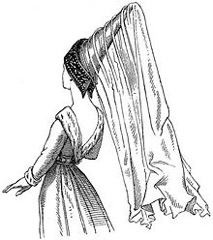
  • How Medieval European Princess Hats are styled off of the headdress of Mongol noblewomen 

    The Mongol Boqta (left) was inspiration for the European Hennin (right).

TLDR: Mongol Babes are badass.